Singapore Sole Proprietorship Registration
Turn your business dream into reality fast! Registering a Sole Proprietorship in Singapore is the quickest and most affordable way to get your venture up and running.
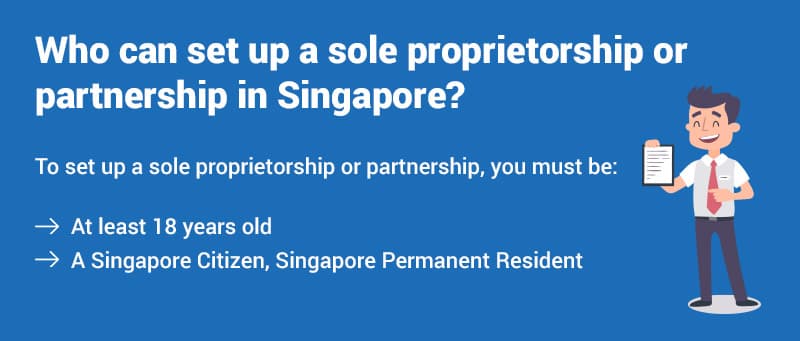
A Sole Proprietorship is the simplest form of business entity with only one owner who is the decisive authority and responsible for all assets and liabilities belonging to the business. Singapore citizens or permanent residents may register a Sole Proprietorship. Foreign individuals and companies may also register a Sole Proprietorship but must appoint a local resident manager.
Requirements for a Singapore Sole Proprietorship Registration
- Natural person, at least 18 years of age, or a Singapore registered company; Singapore Citizens or PRs must ensure that their Medisave has sufficient funds before registration
- A local manager who is either a Singapore Citizen or Permanent Resident, at least 21 years of age
- A Singapore-based manager for foreign individuals and companies
- Proposed business name
- Local business address
What Do You Need to Know Before Registration?
Business Name
The business name must be approved by ACRA before the Singapore Business can be registered. ACRA will reject a proposed business name if:
- It is identical to another existing Company Name
- It is undesirable
- It is similar to established Names and Trademarks such as Coca-Cola and Temasek
Managers
Appointment of a manager for Singapore Sole Proprietorship is required only if it is registered by a foreign individual or company. The manager must be an “ordinary” resident in Singapore, which means a Singapore citizen, a Singapore permanent resident, or a person who holds an Employment Pass, EntrePass, or a Dependants’ Pass.
Registered Address
Every business registered in Singapore is required to have a registered office address. The registered address must be a physical address and cannot be a PO Box. The use of residential addresses is allowed for certain types of businesses.
Opening of a Corporate Bank Account
Once the Sole Proprietorship has been registered, you may open a corporate bank account with any of the local or international banks based in Singapore.
Features of a Sole Proprietorship
- It does not have a separate legal entity
- The owner has unlimited liability
- It cannot own property
Advantages of Sole Proprietorship
- No annual returns filing is required of a Sole Proprietorship as income is taxed at the personal income tax rate.
- Very few compliance requirements and written documentation.
- The business itself is flexible. Any decisions and changes can be made easily as there is only one person to make the relevant choices.
- All the profits generated by the business will belong to the Sole Proprietor.
- Sole Proprietor owns his business, so is able to sell or transfer it as he wishes.
- Easy to administer and manage because of undivided authority and control.
- Less administrative duties, and ongoing compliance requirements.
- All the profits generated by the business will be taxed at the personal income tax level.
Related Post: What are the pros and cons of setting up a Sole Proprietorship in Singapore?
Disadvantages of Sole Proprietorship
- A Sole Proprietorship has unlimited liability. This means that the Sole Proprietor is responsible for all debts and losses of the business, which can put all personal assets at risk.
- In the event of a business failure, the creditors can sue the sole proprietor for all debts incurred.
- As there is only one person with overall responsibility for the success of the business this may increase the pressure on that individual.
- If the registration of the sole proprietorship/ partnership is not renewed on time, the Registrar has the authority to cancel the business.
- Lack of continuity; the business is identified with the owner and therefore not perpetual and it ceases with the death of the owner and is not transferable by part.
- Sole proprietors do not enjoy tax exemptions and rebates available to corporations.
Post-Registration Considerations and Compliance for Sole Proprietorship in Singapore
Licenses and Permits
Some business activities in Singapore are subject to regulation by government authorities. Even if your business firm has been registered you cannot begin operation unless you have the necessary approval or license from the relevant government authorities.
Registered Office Hours
You must have a registered office address and the office must be open to the public for a minimum of three hours per day during normal business hours on weekdays.
Registration Number
Business registration numbers issued by ACRA must be on all letterheads, invoices, billings or other documents used for official business communications.
Customs Registration
If your business activities involve import, export and trans shipment in and out of Singapore, you will need to register your business with the Singapore Customs and obtain a Central Registration Number, commonly known as CR Number. The central registration number is mandatory for Singapore companies or organizations engaged in trading activities.
Singapore Goods and Services Tax Registration
Goods and Services Tax (GST) is a tax on the supply of goods and services in Singapore and on the import of goods into Singapore. Goods exported from Singapore and international services provided from Singapore are exempt from GST. The current rate is 9% (w.e.f. 1st January 2024).
All Singapore businesses must register for GST if their annual taxable revenue is more than S$1 million, or currently making taxable supplies and the annual taxable revenue is expected to be more than S$1 million. The business is expected to register for GST within thirty days from the time it is deemed liable.
You may also choose to register for GST voluntarily. Approval for voluntary registration is at the discretion of the Comptroller in IRAS. Once approval is given, you must remain registered for at least two years.
More on: How to Register for GST? »
Registration of Singapore Central Provident Fund (CPF)
The Central Provident Fund or CPF is a compulsory pension fund scheme in which the employer and employee contribute a percentage of the monthly salary to the fund.
CPF contribution by the employer is mandatory for all local employees who are Singapore citizens or permanent residents earning more than S$50 a month.
The maximum CPF contribution rate for employers and employees is 14.5% and 20% respectively and can be lower depending on certain factors such as employee age, permanent resident status, etc.
More frequently asked question on Central Provident Funds »
Tax on Singapore Sole Proprietorship
A Singapore Sole Proprietorship, though a tax resident, is not considered as a company entity; therefore its profit is taxed at Singapore personal income rate. To learn more on the tax rates, please refer to Singapore personal tax rates.
In the event where the owner is a company, the profit from the Sole Proprietorship will be taxed at the corporate tax rate. To learn more, please refer to Singapore corporate tax rates.
Approval and Renewal Information
Rikvin can help you register a Sole Proprietorship with ACRA within a few minutes. Once approved, ACRA sends out a confirmation of registration via email. The registration is valid for one year and is subject to an annual renewal. Sole proprietors will be required to top up their Medisave accounts as a pre-condition to renewal.
Cessation of Sole-Proprietorship Business
A Singapore sole proprietorship business will cease when the proprietor either dies or otherwise ceases to carry on business. The Business Registration Act requires any person registered under it who has ceased to carry on business to notify the Registrar of this. Failing to do so is an offence and may result in the imposition of a fine.
People also ask
- Step 1: Select a business name.
Step 2: Decide on a local business address.
Step 3: If you’re a foreigner, appoint a local authorized representative.
Step 4: Complete the registration process through ACRA’s BizFile+ platform. - Inform ACRA: Notify the intention to close the sole proprietorship through the BizFile+ portal.
Settle obligations: Clear any outstanding debts and fulfill obligations.
Revoke licenses: Cancel licenses and permits associated with the business.
Asset disposal: Dispose of assets as needed.
Note: The closure process may vary based on individual circumstances and business characteristics. - Foreigners residing abroad: Need to appoint a local authorized representative and engage a filing agent for application submission. Eligible representatives include Singapore citizens, Permanent Residents, Employment Pass, and EntrePass holders.Foreigners living in Singapore: Must seek approval from the Ministry of Manpower or the Immigration Checkpoint Authority (ICA) to register.
- For sole proprietorships in Singapore, the taxation is based solely on the business income of the individual. Singapore employs a progressive income tax system for tax residents, ranging from 0% to 22% depending on the business earnings.
Ready to incorporate a Singapore Sole Proprietorship Business?
As an established company registration service provider in Singapore, Rikvin has specialists who can advise you on your incorporation needs and answer any queries that you may have.